What sinam does with what you give it.
We follow one of your sentences from start to finish: what happens to it, where it lands, and what you can do with it afterwards.
Two seconds, no decisions.
A thought, a task, a name, a date. You dictate or type, and it is done. No category to choose, no folder to create, no title to come up with.
- On your phone as on your computer, from the Capture tab
- By voice: you speak, you tap when you are done. Transcription happens on the device, and recognises the names your memory already knows
- The day's feed shows you what you just captured, and what was made of it
- With no connection, your sentence waits quietly and goes out on its own when the connection is back
Remember to call the garage back before Friday
Léa is allergic to nuts, don't forget for Sunday
Last night's film was much better than I expected
Sorted right away, and gone over at night.
Sorting starts as soon as you have captured: ten seconds or so later, what was understood appears in your Memory.
Then, at regular intervals, the whole thing is taken up again: summaries are rewritten, what you no longer reopen is left to fade, your weekly digest is prepared, and anything that could not be sorted for lack of a connection is caught up. Reading several captures at once also helps work out who you mean when you say “him”, “that project” or “yesterday”.
On a computer, the local model does all this work without sending anything anywhere. With your Anthropic key, only the text of your captures goes out, just long enough to be read.
- Each fact has a confidence level, depending on how you said it
- When unsure, nothing is quietly thrown away: it goes to “To review”, and you decide
- If one capture gets stuck, the others carry on without it
Your sentence is kept
It stays yours, word for word, even if the sorting fails.
It is read and sorted
People, facts, tasks, dates, links.
Everything is gone over
Summaries rewritten, digest prepared, and whatever was missing caught up.
What you no longer reopen fades
Without disappearing. It is shown to you again before it goes dark.
Cards you never had to make.
An entity, someone, a place, a project, appears as soon as you mention it. Its card fills up as you capture, and its summary is rewritten when the facts change. Nothing is set in stone, and there is nothing for you to keep up to date.
People, places, companies, ideas, pets. If you rename one, the old name stays on as an alias.
Grouped by theme when the list gets long, with their confidence and the sentence they came from.
A link you can follow, visible from both sides, and not the same thing noted twice.
What comes up often enough to get its own thread, with everything attached to it.
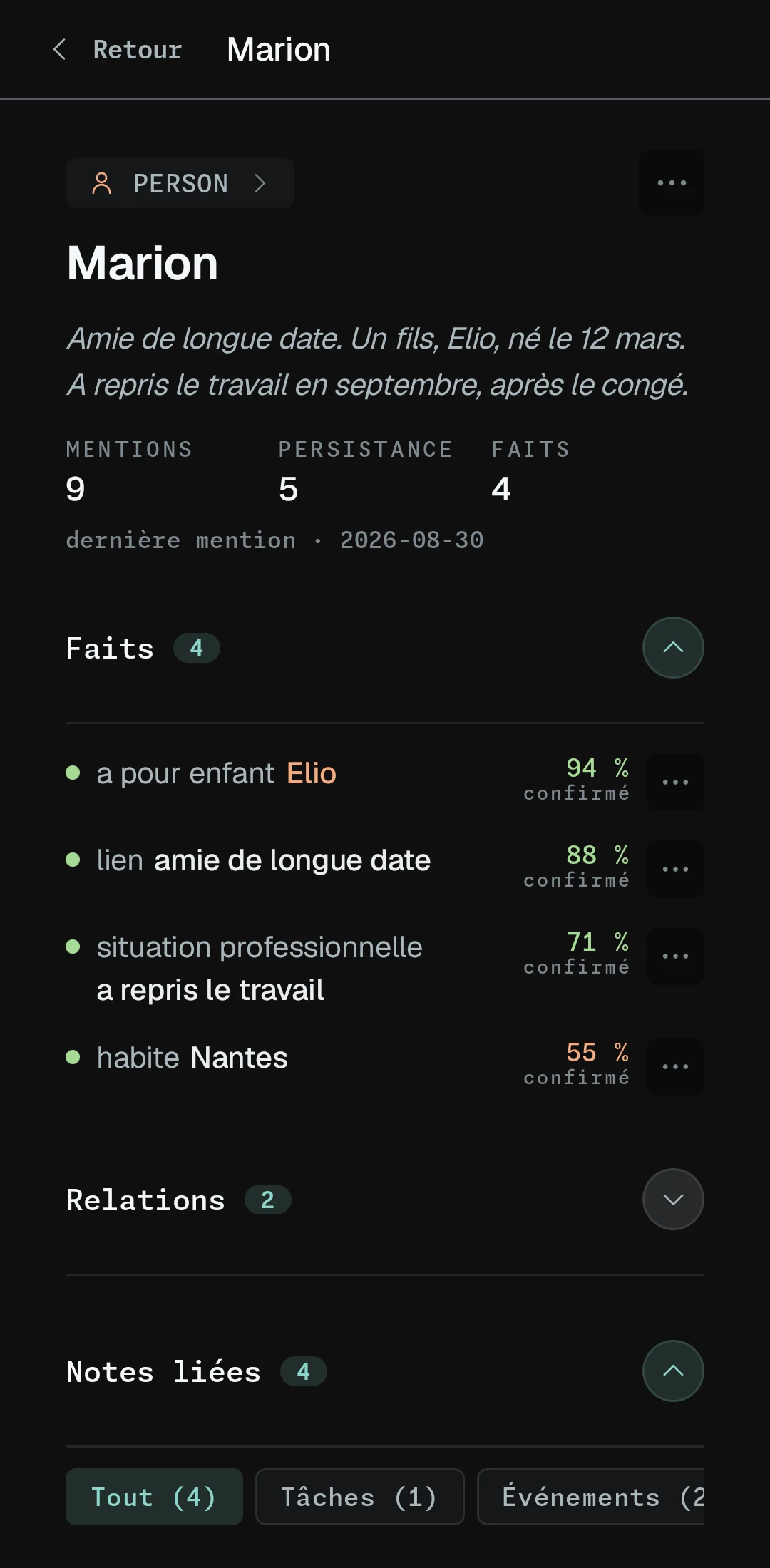
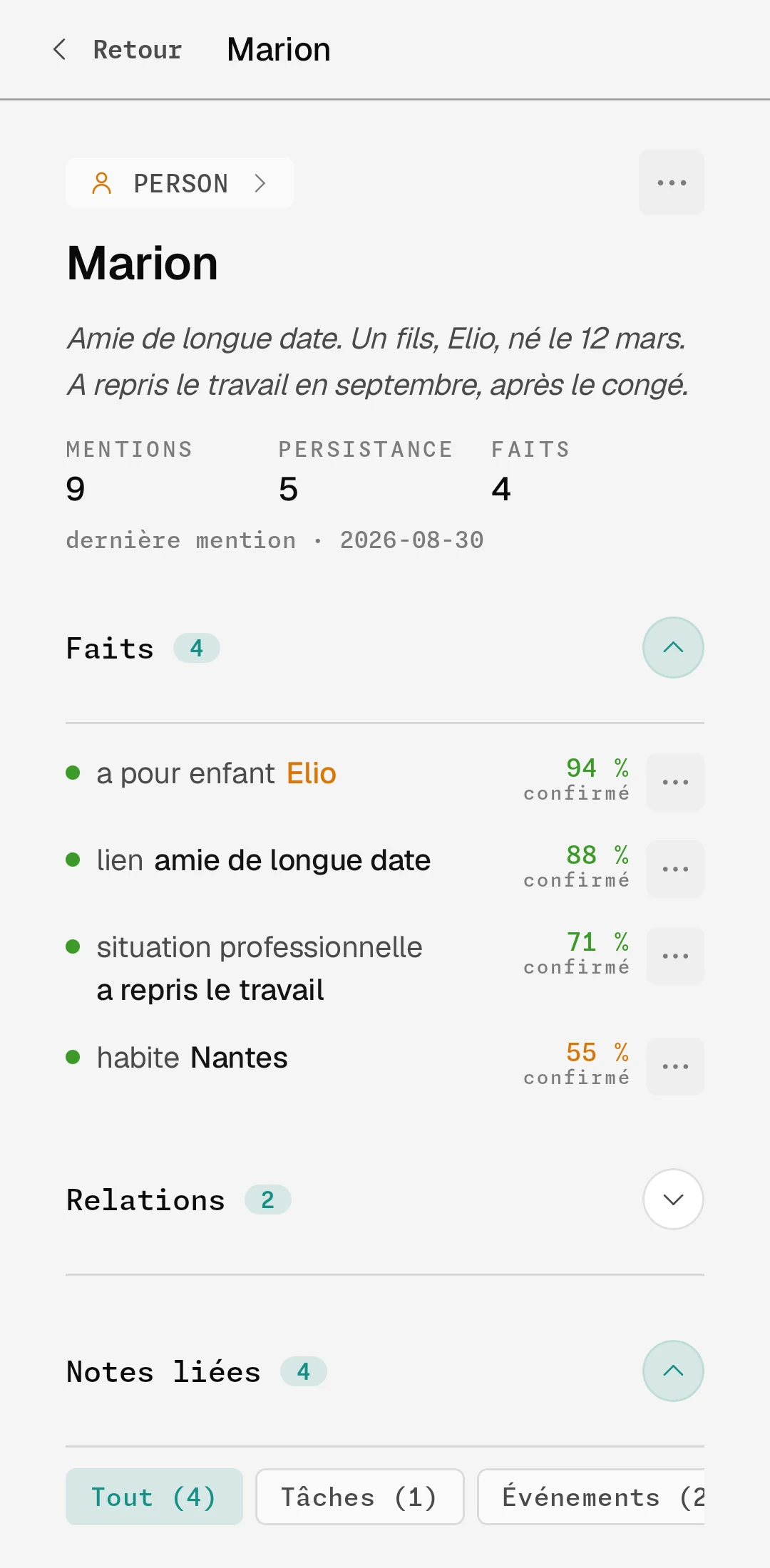
Nobody wrote it.
Marion appeared the day you mentioned her. Her summary is rewritten when the facts change. The three counters at the top show how many times she came up, how strongly she holds, and how many facts are attached to her name.
each with its confidence as a percentage, and a way to correct it in one tap
the link to Elio, visible from both sides
everything that mentions her, with tasks and events set apart
Anything the sorting was unsure about does not come up here: it goes to the To review queue, the badge at the top of the screen.
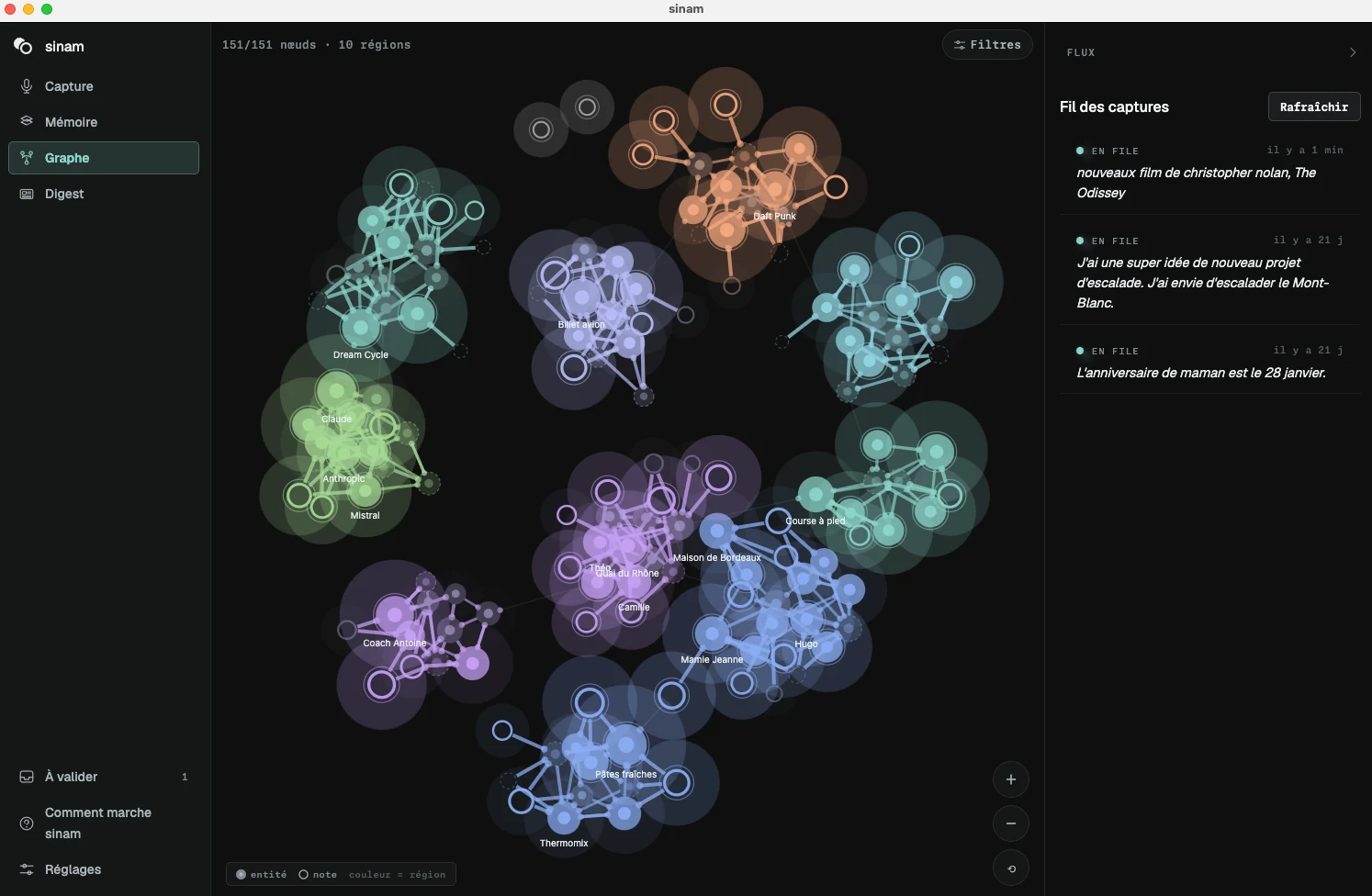
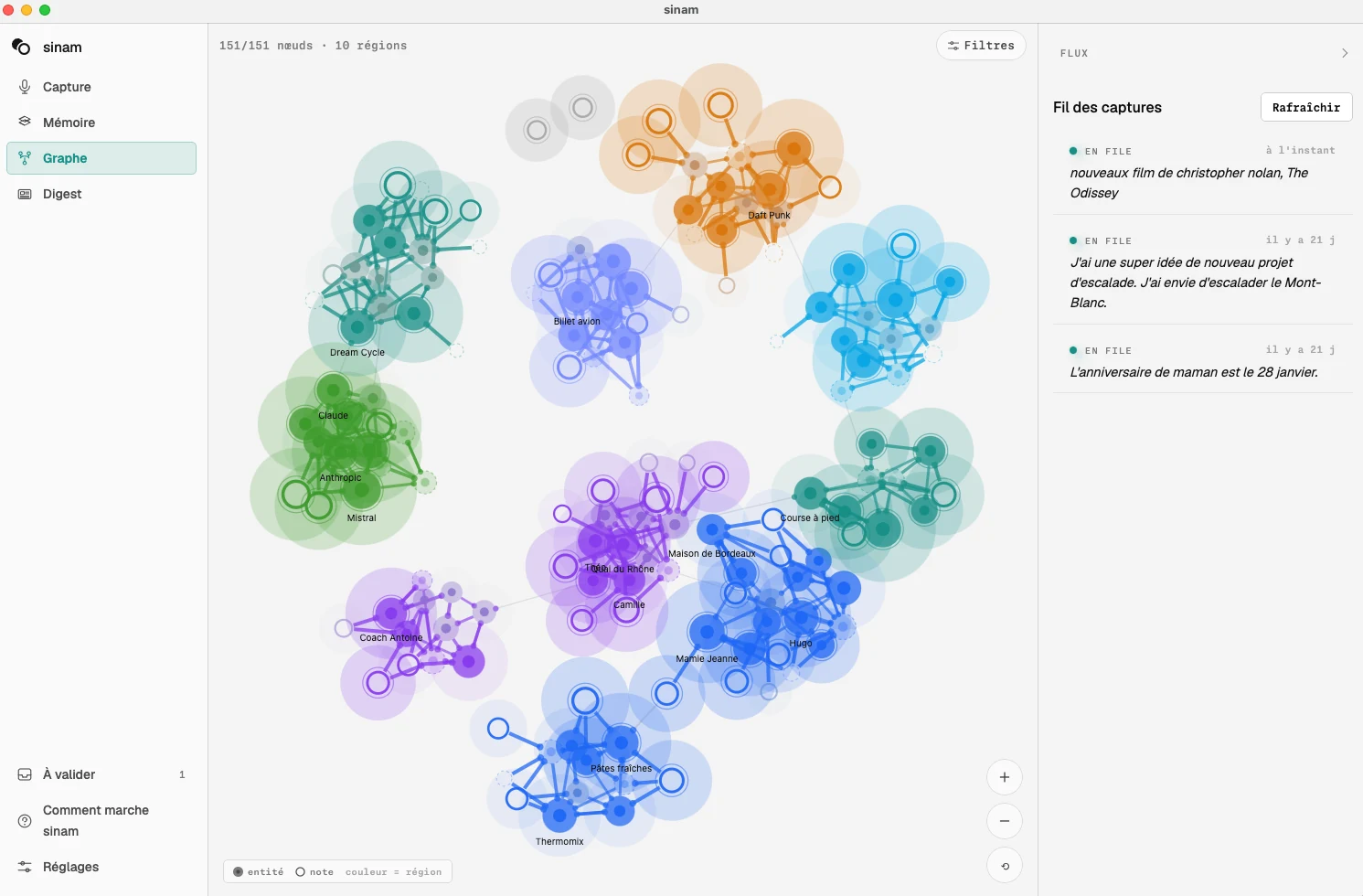
A map that shows what is alive.
Three things to read, and nothing decorative.
shows the region: groups form on their own
shows what it is: a disc for an entity, a ring for a note
shows what is still alive: what is dying out fades
Filter by type or by region, or keep only the most alive. Click a point, and its card opens alongside.
What surfaces: to keep, to do, coming up.
- Forgetting: what is slowly fading, and one tap to keep it
- Tasks: no deadline, no checkbox. What you let slip goes away on its own
- Upcoming: your next seven days, birthdays included
- And a summary of your week, prepared without you
The Portuguese restaurant Sofia mentioned in March strength 0.2
The bookbinding workshop idea noted one Sunday evening strength 0.3
Léa's birthday
The first two cards fade on their own. Hover over them to light them up again: that is the product's gesture.
Your memory, connected to your AI.
From the desktop app, you open your memory to your AI assistant: it searches it, reads a card, and can even drop a capture in for you. It goes through an open standard, MCP, so it works with Claude as well as the others.
- Find what you know about a person, a project, a decision
- Drop in a capture without leaving your conversation
- Settle with it what the sorting could not decide
This door only exists on a computer. With the phone alone, your memory works fully, but no assistant connects to it.
The same engine exposes a documented HTTP API and an MCP server. They are open source, and usable without our apps.
The open-core boundaryEvery device has the whole memory.
Every device keeps your whole memory, readable offline, and catches up on what it is missing as soon as it finds the other one again. You can capture on both sides, even offline.
- Scan a QR code, or type six digits if the device has no camera
- Keys are exchanged directly between your two devices, encrypted
- Only one device does the background work: sorting, summaries, forgetting, digest. You move that role in one tap
- On the same Wi-Fi, directly, from one device to the other. No server in between, so no server to trust
The simplest thing is to try it for a week.
A second brain that sorts itself, on your own devices.
Product
- How it works
- Features
- Download
- Pricing
- Documentation under construction
- Changelog under construction
Around
- Community
- Sila–Nunam
- Français · English